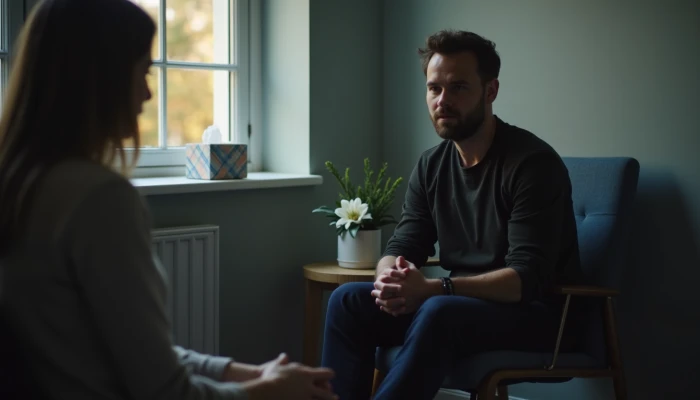
Why Masculinity Norms Can Make Therapy Feel Harder to Reach
For many men, the hardest part of therapy is not finding a provider or making time for an appointment. It is getting past the feeling that asking for help means failing at being strong, capable, or in control.
That pressure does not come out of nowhere. Cultural expectations around masculinity often reward self-reliance, emotional restraint, and pushing through pain without support. Those traits can sometimes help in work, sport, or crisis. But when stress, anxiety, depression, burnout, or relationship strain build up, the same habits can make it harder to notice a problem, talk about it clearly, or reach out early.
This matters for men's mental health because avoiding support does not make distress disappear. It often shows up somewhere else instead: irritability, emotional numbness in men, sleep problems, anger after work, withdrawal, substance use, or conflict at home.
The good news is that therapy does not have to be framed as passive, vague, or at odds with a man's values. Many men engage better when support is practical, respectful, and focused on strengths. This article looks at the cultural norms that can block help-seeking, how strength-based therapy approaches can reduce that friction, and what steps can make access to care feel more realistic.
Cultural Norms and Barriers to Help-Seeking
Traditional ideas about masculinity do not affect every man in the same way, but they often shape what feels acceptable to admit, feel, or ask for. If a man has learned that strength means handling problems alone, therapy can feel less like support and more like proof that he could not manage on his own.
Research and clinical guidance commonly point to a few repeating barriers. Emotional vulnerability may be seen as weakness. Mental health struggles may be minimized until they interfere with work, relationships, or physical health. And help-seeking may be delayed because many men are socialized to value endurance over openness.
That can make common warning signs easier to miss. Instead of saying "I feel depressed" or "I feel anxious," a man may notice different patterns first.
- Feeling constantly on edge or shut down
- Losing interest in people or activities
- Snapping at others over small things
- Using work, exercise, alcohol, or distractions to avoid feelings
- Trouble sleeping or never feeling rested
- Pulling back from friends, family, or a partner
These patterns do not automatically mean a specific diagnosis, but they can be signs that support would help.
Another barrier is stigma. Some men worry that therapy will involve being judged, pushed to talk before they are ready, or treated as if their coping style is the problem. Others simply do not know what therapy actually looks like, what kinds of professionals exist, or how to find a good fit. Lack of clarity can reinforce avoidance.
A useful way to think about it is this: the barrier is often not just "men do not want help." It is that many men have been given a narrow script for what strength is supposed to look like. If the script says stay quiet, stay useful, and do not need anyone, then therapy can feel like breaking a rule.
That script also affects relationships. Partners, relatives, and friends may see distance, anger, or shutdown without realizing those behaviors can be part of stress, burnout in men, or signs of depression in men. When everyone around a man expects him to keep functioning no matter what, it becomes easier for real distress to stay hidden.
None of this means masculinity itself is the problem. The issue is rigidity. When a man feels he has only one acceptable way to cope, his options shrink right when he may need more support, not less.
Strength-Based Therapy Approaches for Men
One reason some men disengage from therapy is that they expect it to focus only on deficits: what is wrong, what is broken, or what they have failed to do. A strength-based approach can reduce that resistance by starting somewhere more workable.
Instead of asking only what symptoms are present, strength-based therapy asks what resources, values, skills, and past coping abilities already exist. That does not ignore pain. It puts pain in a context that still includes competence, effort, and resilience.
For men who are wary of therapy, that shift can matter. It can make support feel less like surrender and more like a practical process for understanding what is happening and building on what already works.
Male-friendly approaches often help by doing a few things well.
- They respect that some men communicate more easily through action, examples, goals, or problem-solving than through immediate emotional disclosure.
- They connect therapy to values such as responsibility, protection, steadiness, and follow-through.
- They allow emotional insight to develop without forcing a style of conversation that feels unnatural from the start.
- They treat help-seeking as a skill, not a weakness.
This does not mean men only want solutions and never want depth. It means the path into therapy may be easier when the process feels collaborative and concrete.
A simple comparison can help clarify the difference.
| Framing that may increase resistance | Framing that may increase engagement |
|---|---|
| "Tell me everything you feel right away" | "Let's start with what has been hardest lately and what you want to change" |
| "Here is what is wrong" | "Here are the patterns we can work on and the strengths you already have" |
| "You need to open up more" | "We can find a way of talking that works for you" |
| "Therapy means depending on someone else" | "Therapy can be a tool for building skills and making clearer decisions" |
Research and background guidance on men's service engagement suggest that many men respond better when support is framed as active, strength-based, and aligned with agency rather than passivity. That does not mean every man prefers the same style, and it does not mean emotional work is avoided. It means the starting point matters.
This approach can be especially useful for men dealing with stress management for men, emotional shutdown, or burnout. Someone who says, "I do not know what I feel, I just know I am exhausted and angry," may still be ready for therapy if the work begins with sleep, routines, stress load, conflict patterns, or practical coping strategies.
In that sense, strength-based therapy is not about protecting stigma. It is about lowering the entry barrier so men can actually engage in care.
Practical Steps to Overcome Stigma and Access Care
If masculinity norms have made therapy feel uncomfortable, the goal is not to force yourself into a version of help that feels fake. The goal is to make support easier to approach in a way that still respects your values.
Start by reframing what therapy is for. Therapy is not a test of toughness, and it is not only for people in visible crisis. It can be a structured place to understand patterns, improve communication, manage stress, and reduce the fallout that untreated strain can have on work, health, and relationships.
If you are unsure where to begin, use this short checklist.
- Name the actual problem in plain language: stress, anger, numbness, sleep issues, panic, burnout, relationship conflict, or feeling stuck
- Decide what you want help with first: coping, communication, mood, habits, or decision-making
- Look for a therapist who mentions experience with men, stigma, burnout, anxiety, depression, or relationship stress
- Ask how they work: structured, goal-oriented, skills-based, insight-focused, or mixed
- Give yourself permission to assess fit after the first session or two
- Tell the therapist if direct emotional language is hard for you at first
It can also help to prepare a first-session script. You do not need a perfect explanation. A few honest lines are enough.
- "I am not used to talking about this, but things have been building up."
- "I do better when conversations are practical and clear."
- "I am not sure if this is anxiety, burnout, or depression, but I know something is off."
- "I want help without feeling judged."
Support from other people also matters. A partner, friend, sibling, coach, faith leader, or doctor can sometimes make the first step easier by treating help-seeking as normal and responsible rather than dramatic. If you are supporting a man you care about, it usually helps more to stay specific than to pressure him to "open up."
Try prompts like these instead.
- "You have seemed overloaded lately. Do you want help finding someone to talk to?"
- "You do not have to have the perfect words to get support."
- "If talking feels awkward, we can start with what has been hardest day to day."
A few mistakes are worth avoiding.
| Less helpful approach | More helpful approach |
|---|---|
| Waiting until things completely fall apart | Reaching out when patterns start affecting sleep, mood, work, or relationships |
| Assuming one bad session means therapy is not for you | Treating fit as something that may take a little adjustment |
| Looking for someone who will "fix" you quickly | Looking for someone who can help you understand patterns and build skills |
| Hiding practical concerns like cost, time, or discomfort | Bringing those concerns up directly so they can be worked through |
If symptoms feel severe, are getting worse, or are affecting safety, daily functioning, or the ability to care for yourself or others, it is important to seek professional help promptly through a licensed clinician, doctor, or urgent local mental health support.
The main point is simple: stigma loses some of its power when therapy becomes specific, practical, and connected to what matters to you. You do not have to reject your identity to get help. You may just need a version of support that meets you where you are.
Conclusion
Cultural expectations around masculinity can make therapy feel harder to reach by linking help-seeking with weakness, dependence, or loss of control. That pressure can keep stress and depression hidden behind irritability, overwork, emotional numbness, or withdrawal.
But those barriers are not fixed. When therapy is framed as practical, collaborative, and strength-based, many men find it easier to engage. The goal is not to force every man into the same model of care. It is to widen the definition of strength so that support, self-awareness, and action can belong in the same conversation.
If you have been putting off help, a useful first step is not to ask whether you are struggling "enough." Ask what is getting harder to carry alone. That question is often a better guide to men's mental health support than waiting for a crisis.