Why Group-Based Support Can Matter So Much for Men in Retirement
Retirement is often described as a reward after years of work. For many men, though, it can also unsettle daily life in ways that are easy to miss. A job may have provided routine, identity, social contact, and a sense of usefulness. When that structure disappears, some men find themselves feeling isolated, flat, irritable, or emotionally shut down.
That does not always look like obvious distress. Sometimes it shows up as withdrawal, anger after small frustrations, poor sleep, loss of motivation, or a sense that nothing feels meaningful anymore. Those can overlap with broader mental health warning signs, including signs of depression in men, but they are not something to self-diagnose alone.
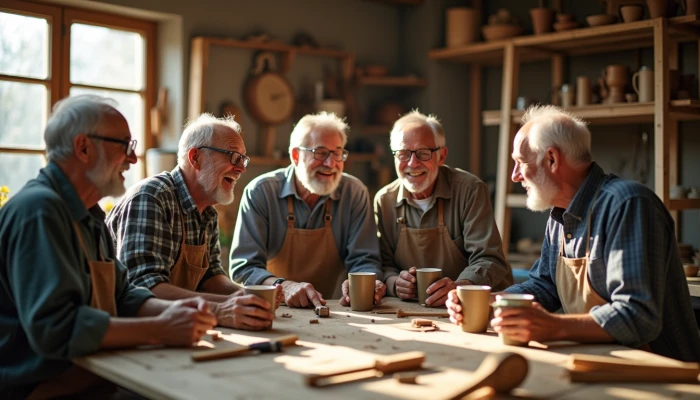
This is where community-based support can help. Practical, low-pressure groups can give older men a place to show up, do something alongside others, and talk when they are ready. Programs like Men’s Sheds are often discussed because they combine activity, autonomy, and peer connection in a way that many men find more approachable than formal mental health settings.
For men looking for men's mental health support, or for loved ones trying to help, the goal is not to treat a group as a cure. It is to understand how community support can reduce isolation, rebuild routine, and make help-seeking feel more possible.
The Role of Community Programs Like Men’s Sheds
Community programs for older men work best when they do more than simply put people in the same room. The stronger models create a shared purpose, a regular rhythm, and enough flexibility for men to participate without feeling pushed.
Men’s Sheds are a well-known example. While the format varies by location, the basic idea is consistent: a welcoming space where men can work on hands-on projects, share skills, spend time with peers, and build connection through doing. That matters because many men find conversation easier when it happens alongside an activity rather than under pressure to open up immediately.
Research on older men’s mental health support groups suggests these spaces can feel safer because they preserve dignity and choice. Men are not only attending a service. They are contributing, deciding how involved to be, and maintaining some control over how they connect with others. That sense of autonomy can be especially important during retirement, when other parts of life may suddenly feel less defined.
These groups may help in a few practical ways:
- They restore routine by giving men a reason to leave the house regularly.
- They create belonging without requiring intense self-disclosure right away.
- They offer peer contact that can reduce shame around stress, sadness, or emotional numbness in men.
- They make it easier to notice when someone seems to be struggling and may need more support.
One qualitative study of older men in community support groups highlighted a simple but important point: some participants felt comfortable enough with the people around them to open up. That does not mean every man will talk deeply or quickly. It does suggest that trust can grow when the setting feels respectful, familiar, and nonjudgmental.
That is also why these groups should not be framed as "just social clubs." For some men, they are one of the few places where connection, purpose, and emotional safety overlap. In practice, that can support stress management for men who are adjusting to retirement, grief, health changes, or relationship strain.
At the same time, a community group is not the same as clinical care. If a man is dealing with persistent depression, severe anxiety, substance misuse, or major functional decline, a group may be a helpful layer of support, but not the only one needed.
Evidence on Social Engagement and Mental Health Benefits
The value of community support is not only intuitive. Research on older adults consistently points to social engagement as an important part of mental well-being.
A systematic review of community-based mental health outreach services for older adults found links with improved overall functioning and reduced psychiatric symptoms in some settings. That does not mean every program works the same way, or that any one group will produce the same outcome for every person. It does show that community-based models can play a meaningful role in support systems for older adults.
Broader research on social connection adds context. Reviews of the literature have found that lacking social connection is associated with serious health risks, including premature mortality. That does not mean loneliness causes one specific outcome by itself. It does underline that isolation is not a minor issue or a personal weakness. It is a real health concern.
Studies on social engagement in later life also suggest a pattern: older adults with more socially meaningful participation tend to report better mental well-being and fewer depressive symptoms. For retired men, that matters because distress may not always look like sadness. It may look like these changes instead:
- Pulling away from friends or family
- Losing interest in routines that used to matter
- Increased irritability or anger
- Low motivation or emotional flatness
- Changes in sleep, energy, or concentration
Those experiences can have many causes, including grief, health problems, chronic stress, or depression. The point is not to label them on your own. The point is to notice that social withdrawal can both reflect distress and make it worse.
Community groups may help interrupt that cycle by offering repeated, low-stakes contact. Instead of asking a man to make one big emotional leap, they create small repeated opportunities to reconnect. That can be especially useful for men who are uncomfortable with formal help-seeking or who worry about stigma.
A simple way to think about it is this:
| Retirement challenge | How a community group may help |
|---|---|
| Loss of routine | Adds regular structure and a reason to show up |
| Identity shift after work ends | Creates roles based on contribution, skill, and presence |
| Loneliness in men | Increases social contact and familiar faces over time |
| Emotional shutdown | Makes conversation more natural through shared activity |
| Hesitation about getting help | Normalizes support through peer connection |
This does not mean social engagement replaces therapy, medication, or medical care when those are needed. It means social connection is one practical, evidence-informed part of supporting emotional health for men in later life.
Practical Steps to Find Local Support Groups
Finding the right group can take a little effort, especially if a man has been isolated for a while. It helps to think less about finding the perfect option and more about finding a reasonable first step.
Start with places that already serve older adults or community well-being. Local senior centers, libraries, community health clinics, faith communities, recreation departments, and aging organizations may know about men’s groups, activity-based groups, peer support programs, or Men’s Sheds initiatives nearby. Some areas also have volunteer programs, veterans' groups, bereavement groups, and hobby-based meetups that offer similar benefits.
If online searching feels easier, look for local directories, municipal community calendars, and nonprofit listings. A family member, partner, or friend can help with the search if technology or motivation is a barrier.
Use this checklist to narrow down options:
- Is the group local enough to attend regularly?
- Does it meet at a manageable time of day?
- Is the setting activity-based, discussion-based, or a mix?
- Does it feel respectful and low-pressure?
- Are new members welcomed in a clear way?
- Is transportation realistic?
- Would going with someone the first time make it easier?
It can also help to treat the first visit as a trial, not a commitment. A man does not have to decide right away whether a group is "for him." Sometimes the best next step is simply attending once, observing, and seeing how the space feels.
A practical sequence looks like this:
- Identify one or two nearby groups.
- Call or email to ask what a first visit is like.
- Ask whether the group is informal, structured, or project-based.
- Arrange transportation and a specific day to attend.
- If possible, go with a trusted friend or family member for support.
- After the visit, ask: Did I feel comfortable enough to come back once more?
For supporters, gentle encouragement usually works better than pressure. Instead of insisting that someone "needs help," try offering concrete support.
For example:
- "I found two local groups. Want me to call with you?"
- "We can just stop by once and leave if it feels off."
- "You do not have to talk about anything personal right away."
If a man seems persistently down, highly anxious, increasingly withdrawn, or unable to manage daily life, community support should be paired with professional evaluation. A primary care doctor, licensed therapist, or local mental health service can help assess what kind of support is appropriate. If there is immediate risk or a mental health crisis, contact emergency services or a local crisis resource right away.
Conclusion
Retirement can ease some pressures, but it can also expose losses that are hard to name: structure, identity, daily contact, and a sense of being needed. For older men, those changes can quietly affect mood, stress, and connection.
Community-based groups can help by offering something practical rather than performative: a place to go, something to do, and people to get to know over time. Programs like Men’s Sheds show why that matters. They create room for autonomy, belonging, and conversation without demanding vulnerability on command.
That is not a cure or a replacement for professional care. It is a realistic, stigma-aware step that can support mental well-being and make further help-seeking easier when needed.
If you are an older man in retirement, or you care about one, the most useful next move may be simple: look for one local group, ask one question, and try one visit. Small steps toward connection can matter more than they first appear.