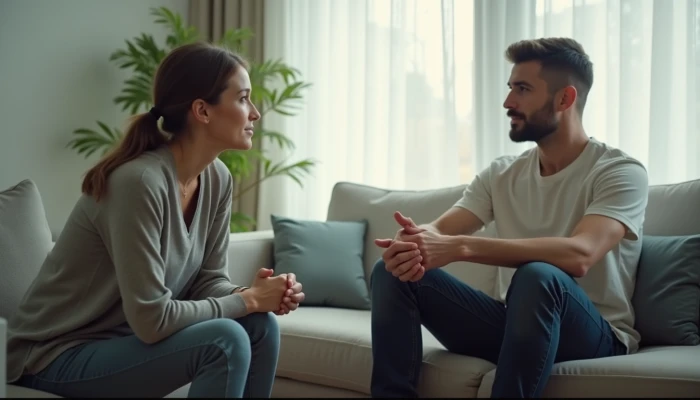
When Your Partner Shuts Down Under Anxiety: Practical Ways to Help
Supporting a partner through anxiety can feel confusing, especially when he does not talk about it in obvious ways. You may notice irritability, withdrawal, overthinking, sleep problems, or a shorter fuse long before you hear the words "I'm anxious."
That can leave partners stuck between wanting to help and not wanting to make things worse. Pushing too hard can lead to shutdown. Saying too little can feel like neglect. Trying to fix everything can create more pressure for both of you.
This guide focuses on practical, source-backed ways to offer men's mental health support in a relationship. The goal is not to diagnose him or force a breakthrough. It is to understand common patterns, communicate more safely, encourage healthy coping strategies, and know when professional help may be needed.
Understanding Male Anxiety and Its Unique Challenges
Anxiety in men does not always look like open fear or visible distress. Research and clinical guidance suggest that many men are shaped by strong social messages about self-reliance, control, and emotional restraint. Because of that, anxiety may come out sideways.
Instead of saying "I feel overwhelmed," he may become quiet, distracted, restless, defensive, or overly focused on work, routines, or problem-solving. Some men overthink relationship issues, seek reassurance, pull away physically or emotionally, or seem constantly on edge. Those behaviors can be frustrating, but they are often easier to show than vulnerable feelings.
This matters in close relationships because romantic partners are often the people men are most likely to open up to, even if only partially. At the same time, fear of judgment, shame, or conflict can make him censor himself. He may worry that talking about anxiety will make him seem weak, incapable, or like a burden.
That tension can create a painful cycle:
- He feels anxious but says little.
- You notice distance or tension and ask what is wrong.
- He feels pressured or misunderstood and shuts down more.
- You feel helpless, rejected, or alone.
Understanding this pattern does not excuse hurtful behavior. It does help you respond more accurately. If you can see anxiety as something affecting the relationship, rather than as a character flaw, you are more likely to choose responses that lower defensiveness and increase trust.
Building Safe Communication Spaces
If your partner struggles to talk about anxiety, the first job is not to get a full explanation. It is to make the conversation feel safe enough to enter.
That usually means lowering pressure. Many people try to help by demanding honesty, asking rapid-fire questions, or insisting on a big emotional talk right away. For someone already anxious, that can feel like one more test to fail.
A safer approach is to invite, not corner. Choose a calm moment rather than the middle of an argument. Keep your tone steady. Focus on what you have noticed, not what you assume.
You can try phrases like:
- "You seem more stressed lately. I'm here if you want to talk."
- "I don't need you to explain everything right now. I just want to understand what this has been like for you."
- "Would it help to talk while we walk or drive instead of sitting face to face?"
- "If talking feels hard, you can tell me in pieces."
Open-ended questions tend to work better than yes-or-no questions or loaded questions. Instead of "Why are you acting like this?" try "What feels hardest lately?" Instead of "Are you anxious again?" try "What has been weighing on you most?"
It also helps to recognize that talking is not the only form of communication. Some men express themselves more clearly during shared activity, after exercise, while driving, through texting, or by writing things down first. That is not avoidance by default. It can be a more manageable path into honest conversation.
Use this quick communication checklist before bringing up a hard topic:
- Am I choosing a calm time rather than a heated moment?
- Am I describing what I notice instead of accusing?
- Am I asking one question at a time?
- Am I ready to listen without interrupting or fixing?
- Am I allowing silence instead of rushing to fill it?
- Am I accepting that he may share gradually?
Safe communication does not mean saying nothing about your own needs. It means creating conditions where both people can be more honest and less defensive.
Emotional Support Techniques for Partners
Good support is usually steady, respectful, and specific. It is less about having the perfect words and more about helping your partner feel less alone while keeping healthy boundaries.
Start with validation. Validation does not mean agreeing with every fear or telling him his anxiety is accurate. It means acknowledging that his experience is real.
Helpful responses often sound like:
- "That sounds exhausting."
- "I can see this is weighing on you."
- "You don't have to pretend you're fine with me."
- "I may not fully get it yet, but I want to understand."
Unhelpful responses often sound like this:
| Instead of | Try |
|---|---|
| "Just relax." | "What helps you feel a little more grounded?" |
| "You're overthinking." | "It sounds like your mind won't let this go." |
| "Everyone gets stressed." | "This seems to be hitting you pretty hard." |
| "Tell me everything right now." | "We can take this one step at a time." |
| "You need to fix this." | "We can think about support together." |
You can also support healthy coping strategies without becoming his manager. Gentle encouragement works better than policing. Depending on what fits him, that might include:
- regular movement or exercise
- consistent sleep habits
- less alcohol when stress is high
- time outside
- breathing or grounding exercises
- journaling or voice notes
- structured downtime after work
If anger after work, emotional numbness in men, or constant withdrawal is showing up, it may help to talk about stress patterns rather than labeling him. For example: "I've noticed evenings seem especially hard. What would make that time feel less overloaded?"
At the same time, remember your role. Supporting someone is not the same as becoming their therapist. You cannot monitor every mood, prevent every spiral, or carry the whole relationship alone.
A balanced support approach looks like this:
- Notice patterns without attacking.
- Validate the experience.
- Ask what kind of support would help.
- Encourage one or two realistic coping steps.
- Keep your own limits clear.
This is especially important for partners searching for advice on supporting a depressed partner or an anxious partner. The same principle applies: compassion helps most when it is paired with clarity, patience, and realistic expectations.
Guiding Toward Professional Help
Sometimes relationship support is helpful but not enough. If anxiety is persistent, worsening, or affecting daily life, professional support may be an important next step.
Warning signs can include:
- ongoing withdrawal from people or activities
- major sleep problems
- panic symptoms or constant dread
- heavy reliance on alcohol or other unhealthy coping habits
- repeated conflict driven by anxiety, reassurance-seeking, or shutdown
- trouble functioning at work or home
- hopelessness, severe distress, or talk that suggests he may not be safe
How you raise the topic matters. If professional help is framed as "You need to get fixed," he may hear criticism or failure. If it is framed as support, he may be more open.
You might say:
- "You have been carrying a lot, and I don't think you should have to do it alone."
- "Talking to a therapist could give you more support than I can provide by myself."
- "If you want, we can look at options together."
- "Getting help does not mean you've failed. It means this matters."
Make the step smaller when possible. Instead of pushing for a huge commitment, suggest one action:
- looking up a therapist directory
- checking insurance coverage
- asking a primary care doctor where to start
- reading about men's therapy options together
- writing down symptoms and questions before an appointment
If he is reluctant, stay respectful but honest about impact. You can care about him and still say that the current pattern is affecting the relationship.
If there is immediate concern about safety, do not handle it as a routine communication issue. Seek urgent help through local emergency services, a crisis line, or an appropriate licensed professional in your area.
Professional care is not a punishment and not a guarantee. It is one form of support that can help him build skills, reduce isolation, and understand what is driving the anxiety more clearly.
Conclusion
Supporting a partner with anxiety is rarely about finding one perfect conversation. More often, it is about building a pattern of calmer communication, emotional steadiness, and realistic support.
When you understand that men may show anxiety through withdrawal, irritability, overthinking, or silence, your response can become more useful and less reactive. Creating safe space, validating without minimizing, and encouraging healthy coping strategies can make it easier for him to engage instead of shut down.
Just as important, you do not have to do this alone. Professional help can be part of caring for the relationship, not a sign that either of you has failed. The most helpful approach is usually collaborative: honest communication, consistent support, and outside help when anxiety is becoming too much to carry privately.